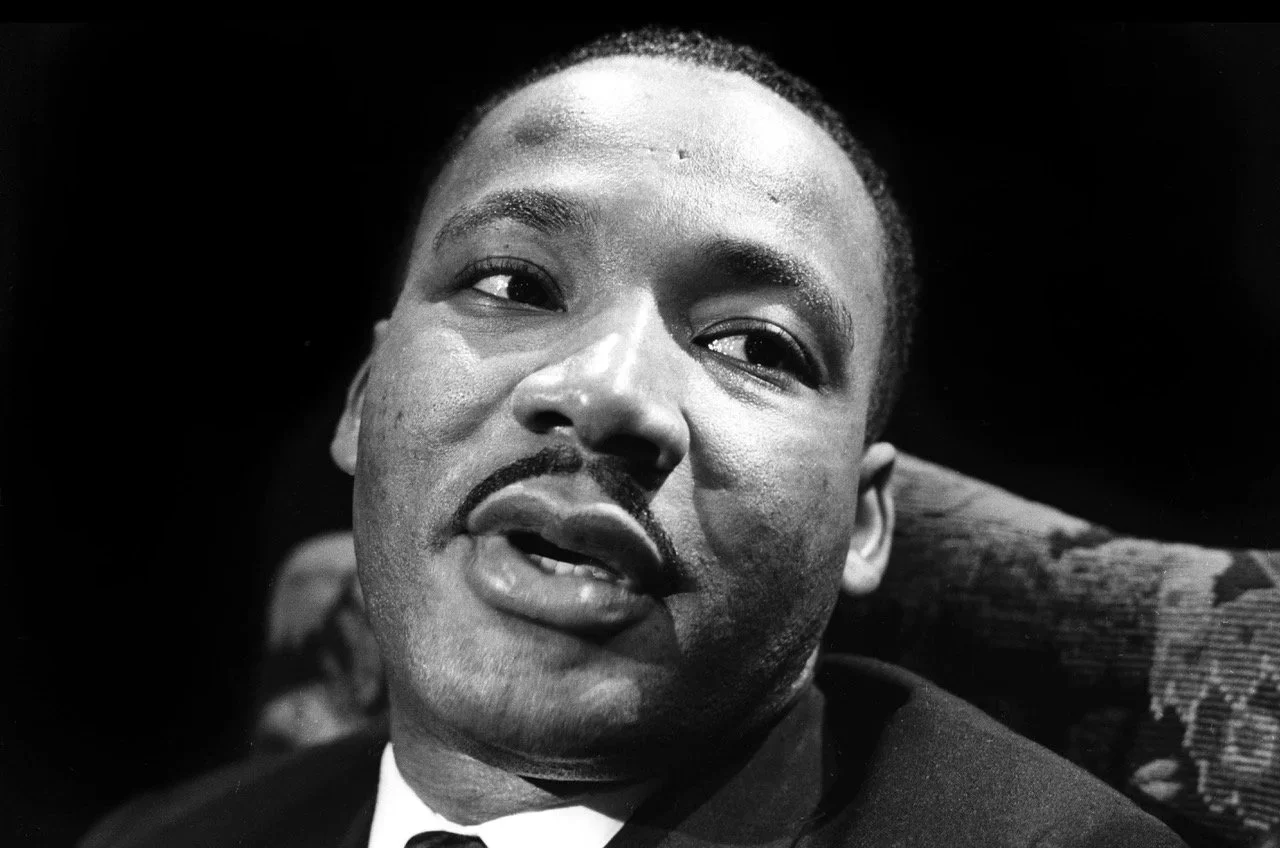
A talk by Megan Hector on March 8th 2026.
Hello everyone, I’m Megan. You normally see me over there in the choir, but today I’ve been given the privilege and the responsibility of giving a talk about someone who most of us are probably already quite familiar with. To give him his full title, the Reverend Dr Martin Luther King Jr. From now on I’ll probably just call him Martin Luther King or Martin, but you know who I mean.
Martin Luther King Jr was born in 1929 in Atlanta, Georgia, and he is well known to many of us as one of the key leaders of the African American civil rights movement in the United States, which was active in the 1950s and 60s. The civil rights movement fought against discrimination, hatred and violence against black Americans, which was embedded in the country’s legal systems and institutions like transport and education, as well as in the country’s culture.
Martin Luther King led countless moments of protest and civil disobedience which made the civil rights movement successful, from marches to sit-ins at segregated cafés, voter registration drives to encourage African Americans to vote, the boycott of segregated buses in Montgomery, and the enormous March on Washington where Martin gave his most famous I Have a Dream speech. In the course of his fight for justice, Martin Luther King Jr endured public abuse, spurious legal cases, arrest, imprisonment, threats against himself and his family, physical assaults, and finally, most sadly, his murder at the tender age of 39.
But how did he find the strength and the vision to take on the burden of this leadership role, and to succeed? One of the answers to this question is his faith in God, and the conviction his faith gave him that he should dedicate his life to struggling for justice, truth, and love. As we heard in the reading from one of Martin’s sermons, there were times when he felt burnt out and in despair due to the immense weight of his circumstances. The constant threat of danger to himself and his family, the burden of being one of the most well known leaders of the movement, whom hundreds of thousands if not millions of people were looking to for reassurance and direction.
The example in the reading is a powerful one. There are other examples from Martin’s life which similarly demonstrate how he felt that God was with him in his fight. On one occasion a year after the story in the reading, Martin was at home and a friend and fellow minister was staying with him. In the middle of the night Martin awoke with a feeling that they needed to leave the house immediately, and they did. A few hours later the house was bombed. God protected this precious leader, and Martin was able to continue his vital work for years longer.
But it’s not just these extraordinary examples of divine intervention that can be inspirational to us. Sometimes one of the things that I find most inspirational and reassuring about Martin Luther King is the fact that he was a flawed and fallible human being, much like the rest of us. He was certainly not a perfect husband to Coretta, and some of his attitudes towards women might seem a little old-fashioned to us today. Sometimes in the course of his work in the civil rights movement he tried tactics that didn’t work, and sometimes he fell out with people. As many of us do, he struggled with feelings of depression, helplessness and despair.
And sometimes he just didn’t feel up to the task at hand. One of my favourite anecdotes is from a time when he made his first trip to India to learn from disciples of Gandhi about the principles of non-violence. The people organising the trip had arranged for Martin to join a very famous disciple of Gandhi on his daily walk, which would go on for miles and miles, in the full heat of the day. The walk was set to start at about 4am. When the day came, Martin more or less said… “Ooh, that seems a bit long… maybe someone could just drive me to meet him halfway?” And that’s what they did.
Despite his flaws and fallibility, or perhaps because of them, Martin Luther King was able to use his gifts of oratory and human connection to touch people’s hearts and stir up their spirits, to communicate to others God’s love and God’s hunger for justice, to inspire those feelings in others and propel people to action. He articulated a beautiful, hopeful vision of how the world could be different, and shared his faith that we can make it so.
The lesson that I take from all of these examples is that none of us needs to be perfect to make a difference. We don’t need to be optimistic or hopeful all the time. It’s okay to feel lost, or disheartened, or powerless, or overwhelmed by the pace of horrible events taking place in our world. We simply have to do what it’s within our power to do, every day, to bring love, kindness, and grace to the people we interact with. To demonstrate God’s love in our words and our actions, and in so doing, to bring the kingdom of heaven on earth.
This, I would say, is the abiding motivation of my entire life, since I became a Christian in my early twenties. I was an atheist before that, but Jesus got me. I work for a homelessness charity in my day job, and every day I see Jesus’s face in the people sleeping rough on our streets. These are some of the people who most need our love, support, and grace.
Aside from Jesus, who is of course my number one guy, the example of Martin Luther King’s life is one that sustains me in my work and activism. His achievements show us that even in the face of incomprehensible adversity, we can still change everything.
Many of us will find this particularly relevant at the moment. The times are very dark, and sometimes it feels like things will never get better. War and violence seem to have taken over our world. My friends sometimes ask me how I seem to stay mostly quite peaceful and hopeful and determined in this context - and I do endeavour to bring a bit of zen calm to my work and activism, although it’s fair to say that a burning hatred of injustice is always simmering under the surface within me. But overall my answer to that question is that I’m rooted in my love of God and my love of my fellow human beings, in my faith that God is with us and that we are his hands and feet in the world. This is the biggest lesson I take from Martin Luther King’s example.
A quick final important point I want to make is that Martin Luther King Jr, while an extraordinary and talented man, did not achieve anything alone. He was surrounded by dozens of friends, family and colleagues, his community, who contributed huge amounts to the work of the civil rights movement and to supporting and enabling him to deliver his inspirational leadership.
If I had to write some extra beatitudes, it would be something along the lines of: blessed are those who do the admin work, who book the rooms, take the minutes and tidy up after the meeting, who organise and cook the food, who draft the first and fourth and tenth version of the speech. The Work is often not glamorous or dramatic or exciting, but it is the business of living every day in a relationship of love and care with others, striving together towards justice.
We make the world, every day. We can make the world different, hand in hand with God.
Every day I struggle for a better world, arm in arm with my friends who are migrants or refugees, people of colour, sex workers, trans people - the people at the margins who God calls on us all to centre. And I’m very grateful to do all of that, in community with all of you too. Thank you.