A talk by Rhian Roberts on March 1st 2026.
During Lent the talks at St Luke’s are on the theme of A Saint I Could Believe In.
As it’s March 1st, St David’s Day and I am 100% Welsh it felt like the ideal time to share St Melangell with you.
Feel free to close your eyes as I tell you her story and what she’s led me to think about.
Let me place us first in the area named after her, Pennant Melangell, in mid Wales.
Imagine.
It’s the present day. We are at the head of a deep valley formed by ancient glaciers. On either side of us roll the Berwyn Hills, still densely covered with pine, conifer and heather. It is a magical place, site of Bronze age burial grounds and the story of a goddess who rides an enchanted horse slowly up the mountains; a goddess of the natural world, of protection, transformation and endurance.
Pennant Melangell is not a place that is sought out, mostly quiet still, not a magnet for the tourists drawn to Wales by castles and beaches and the wonders of Eryri and Yr Wyddfa. The guidebooks warn us there are no services available here in this valley. Instead above wheel hen harriers, merlins and buzzards – it’s one of their favoured breeding grounds.
Now let’s go back to the Middle Ages, the 7th century. A woman arrives in the valley. This is Melangell. She has travelled from Ireland. A woman from a noble family who didn’t want the arranged marriage planned for her. She settles in this Welsh valley instead to live alone amongst the birds and animals, wide skies above her and the peace of the natural world around her. We might describe her as a hermit, a woman who has retreated to a life of solitude and prayer.
She lives there for 15 years. Then one morning Melangell is disturbed by the sound of hunters, with horses and dogs, crashing through the forest in pursuit of their quarry. Into her clearing bounds a terrified hare; Melangell sinks to the ground and offers the creature sanctuary under the hem of her skirt just as the hunt arrives.
The dogs continue their frenzied barking, but they become strangely fearful to approach, despite being urged on to capture the hare by their master, Prince Brochfael Ysgithrog. Melangell takes her chance to tell her story to the Prince, explaining her desire to continue living in the valley, spending her days in prayer and without the company of men. Impressed by the woman’s words and her steadfast determination, the Prince calls off his dogs and is moved to give the valley to Melangell as a place of perpetual sanctuary, where none can be hunted.
Over the succeeding years it becomes known as a retreat and refuge for women. Others join her. She is spoken of as a protector of God’s creatures too – especially rabbits and hares; they behave towards her as if tame. When she dies 37 years later it becomes a pilgrimage site, called Pennant Melangell – ‘the source of Melangell’s stream.’
This story was written down almost 700 years after she died. The text is considered a mix of oral history and folklore but also a defence of the rights of Welsh churches to offer sanctuary. A right which noblemen were in the habit of challenging.
There’s a church at Pennant Melangell and it does have parts which date back to the 8th century. There’s an area known as cell-y-bedd – the grave cell. Recent excavations, under what was always known as the saint’s grave-stone, located and confirmed the remains of a small woman.
It’s said the local people have always refused to hunt hares and rabbits, even when times were very hard. They are known as Wyn Melangell – Melangell’s lambs.
Why choose Melangell as a saint I could believe in?
I first came upon her valley a long time ago travelling across Wales, it’s a breath-taking place. The quietness of it is deeply affecting. At the centre is that church dedicated to this rare saint. A woman who is not raped or tortured or murdered in some unique and alarming way. Neither does her reputation depend on giving birth to, or being the daughter of, a man of great importance. She is purely and simply a woman living in a forest who is a protector of living creatures. She is given land and uses it to extend the offer of sanctuary.
For me Melangell’s attraction resides too in being an agent of change, at a time when change for women was almost impossible. She makes her own destiny and decides her own values. There’s something so unfussy about her, simple, matter of fact, but also formidable.
She is so intertwined with the land, she does not live apart from the world but very close to it. Around the churchyard still there are 4 yew trees, all dated to around two thousand years old. Melangell could have sat beneath them. That continuity is profoundly touching.
Then there’s the layers of time and belief around a particular place of sanctuary. How do we think about all of those elements – often shared as stories down the centuries, rather than as they are captured by the writers of history.
Pagan stories of goddesses who rode the same land, again protectors of the creatures that lived alongside them. Then the Bronze age burial site that circle the location of the current church. Then that church built on layers of earlier churches, with the bones of a woman held at its heart, in memory of a valley of sanctuary. Maybe.
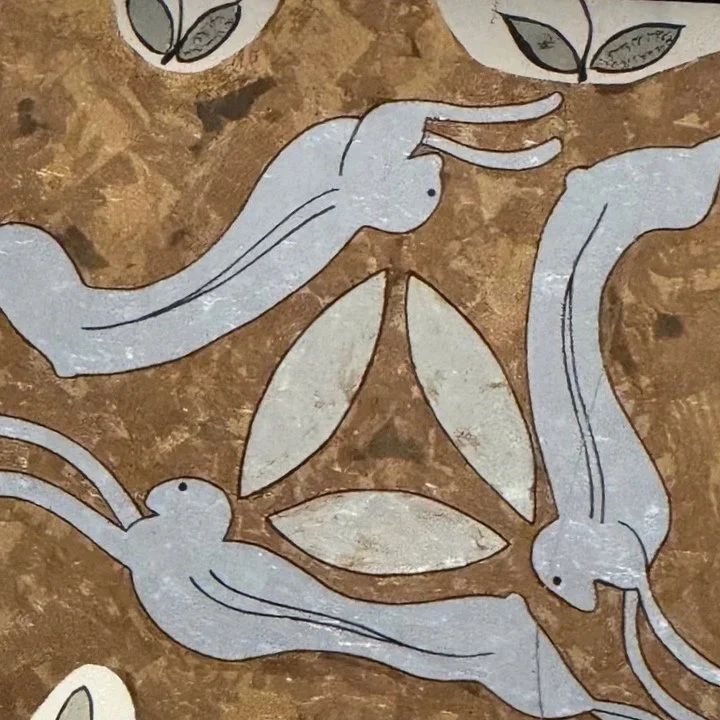
I think of her when I look up at the hares on the ceiling of the chancel at St Lukes.
What does it mean to be a place of sanctuary?
What does it mean to be part of a community which provides sanctuary?
Who gives us sanctuary?
Where gives me sanctuary?
I share with you, Melangell: an agent of change, a protector of the natural world and a saint who reminds us of how connected we can be to ancient times and ancient ideas of sanctuary.