
A talk by Joy Hinson on March 15th 2026.
Have you ever had a vision? I don’t mean a corporate vision or a plan or even a dream, as Martin Luthur King did. I mean a revelatory or ecstatic vision.
They’re not very fashionable just now. We usually dismiss accounts of visions as hallucinations or manifestations of serious illness or drug use. But that was not always the case …..
Both our readings this morning are accounts of visions that were experienced by two women. Visions that profoundly changed their lives. The Gospel reading with its account of the vision of an angel appearing to a young woman and telling her that she’s going to give birth to the son of God marks the start of the story of Mary and her son Jesus. We’re all pretty familiar with that story and how it turns out: Jesus’ birth at Christmas, his life and miracles, and especially in this season of Lent as we prepare ourselves for the story of his crucifixion and death on Good Friday.
We’re much less familiar with the story of our second reading from Mother Julian of Norwich: a saint whose faith I can believe in. Let me tell you about her:
Julian was born in Norwich in East Anglia, almost 700 years ago. Norwich was both wealthy and very religious: all religion of course was Catholic and the bible was only in Latin. We didn’t get an English bible until nearly two hundred years later.
We don’t know for sure very much about her life, but we know that she was able to read and write, so likely to be the daughter of a merchant. When Julian was about six years old the first wave of bubonic plague swept through England, killing between a third and half of all the people. So she will have seen death at an early age. Did she marry? Have children? We don’t know but maybe she did, although it’s clear that she had no living relatives other than her mother when she reached the age of 30.
In May 1373, at the age of 30 Julian became very ill with a fever and almost died. She was given the last rites, but two days later, over the course of just a few hours, she had an extraordinary series of visions, which she called ‘showings’ or ‘revelations’.
Is it something about serious illness, being at the threshold between life and death that thins the membrane that separates earth from heaven, us from God? I don’t know. But it was then that Julian saw vivid visions of Christ on the Cross and a series of scenes that acted out before her.
She wrote an account of the visions after she recovered. They are the oldest surviving works in English written by a woman. Later named ‘Revelations of Divine Love’, they describe her visions and what she felt when saw them. The experience of these revelations had a profound effect on Julian. Her writings became widely known and she developed a reputation as a mystic, a ‘religious’ and a spiritual healer.
When she heard that a local church was advertising for a new anchorite she applied and was accepted. An anchoress (a female anchorite ) was not like a nun, living in a community, working and praying with other nuns, visiting the sick and doing good works. An anchoress lived alone in a single enclosed cell, usually attached to a church. She withdrew completely from the secular world and devoted her entire life to prayer and contemplation. Julian did just this: she entered the cell at the age of around thirty six and lived there in that one small room for the next thirty five years, until she died in 1416.
She would have had an attendant who brought food and drink, emptied the chamberpot. She had a window to the church through which she could hear the daily services and receive communion. And she had a few visitors: the medieval mystic Margerie Kempe, for example, who came to seek her spiritual advice. Otherwise Julian was alone with her thoughts. And she used her time in the cell to reflect on her visions and on the nature of God that those visions revealed to her.
Julian concluded that God is love, specifically mother-love. And that Jesus Christ himself embodies the love of a mother for her children. She drew a direct parallel between a mother using her body to feed her child when breastfeeding, and Christ using his body symbolically to feed us in communion. She outlined a belief that is free of judgement and full of nurturing, acceptance and love.
For me that female character of God was the key: I was brought up in an old fashioned Anglican family: church on Sundays, where God was an old white man. I was sent to school at a Catholic Convent: where God was an angry and vengeful old white man. Women and girls were sinful, not worthy. The only worthy woman was that impossible thing: a virgin mother. Mary. I never got on with Mary……
But then I met Julian who experienced sickness, the death of so many around her and who remained steadfast during terribly troubled times. A real woman. She lived through the peasant’s revolt and through the black death and through a time of violent religious suppression, when writing in English was dangerous and being an influential religious woman was even more dangerous.
Her vision of the universe in a hazelnut, complete in itself because God loves it, allowed me to believe that I as a woman, complete with all my flaws, might too be okay in the eyes of God. She taught me that it is alright to start my prayers with the words ‘Holy Mother and Father of us all’.
And she gave me the freedom to explore my own faith with new and more accepting eyes. At the start I asked if you’ve ever had a vision. About ten years ago I did. Cycling to work one very ordinary spring morning along the canal towpath I suddenly had a moment of purest bliss. Rapture. And a sense of connectedness to the world and belonging in that world. An all-surrounding sense of love, acceptance and peace. With my sceptical scientist’s brain fully in gear (I was on my way to work) I dismissed it as a strange sensation: lovely but strange. I carried on with my day, and that evening told my husband: an odd thing happened this morning.
Now, ten years later, with my sceptical brain grown a little softer and more gentle, I can explore what that experience meant and how I might respond. I am left with a clear understanding that God is pure love and that indeed “all shall be made well and all shall be well and all manner of things shall be well”.
Not some things. All.
Amen
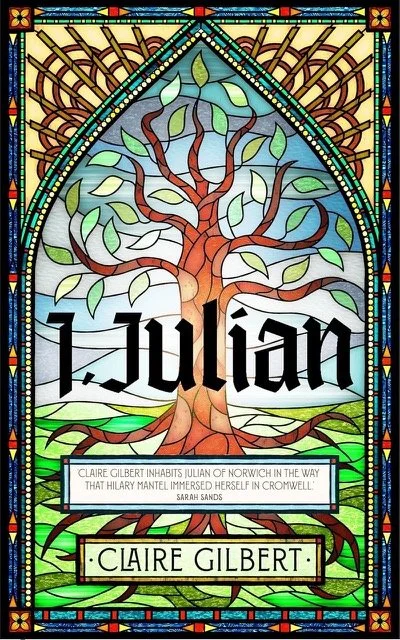
(Image on home page is of the cover of 'I, Julian: The Fictional Autobiography of Julian of Norwich' by Claire Gilbert, published by Hodder & Stoughton)
