A talk by Julius Ajeigbe on March 22nd 2026.
Throughout this series, we’ve been introduced to incredible men and women who have stood firm in the face of injustice, and those who have also brought the world a better understanding of Christian teachings maybe through revelations ..
We’ve heard about...
Julian of Norwich…the English theologian – all shall be well
Alexei Navalny… the Russian opposition leader and political activist, killed in a Russian jail, 2 years ago
Dr Martin Luther King Jr , the American civil rights leader…in the 50s and 60s
And today I’ll be sharing my thoughts on an African saint, a man often called the spiritual father of South Africa, the moral conscience of a nation —
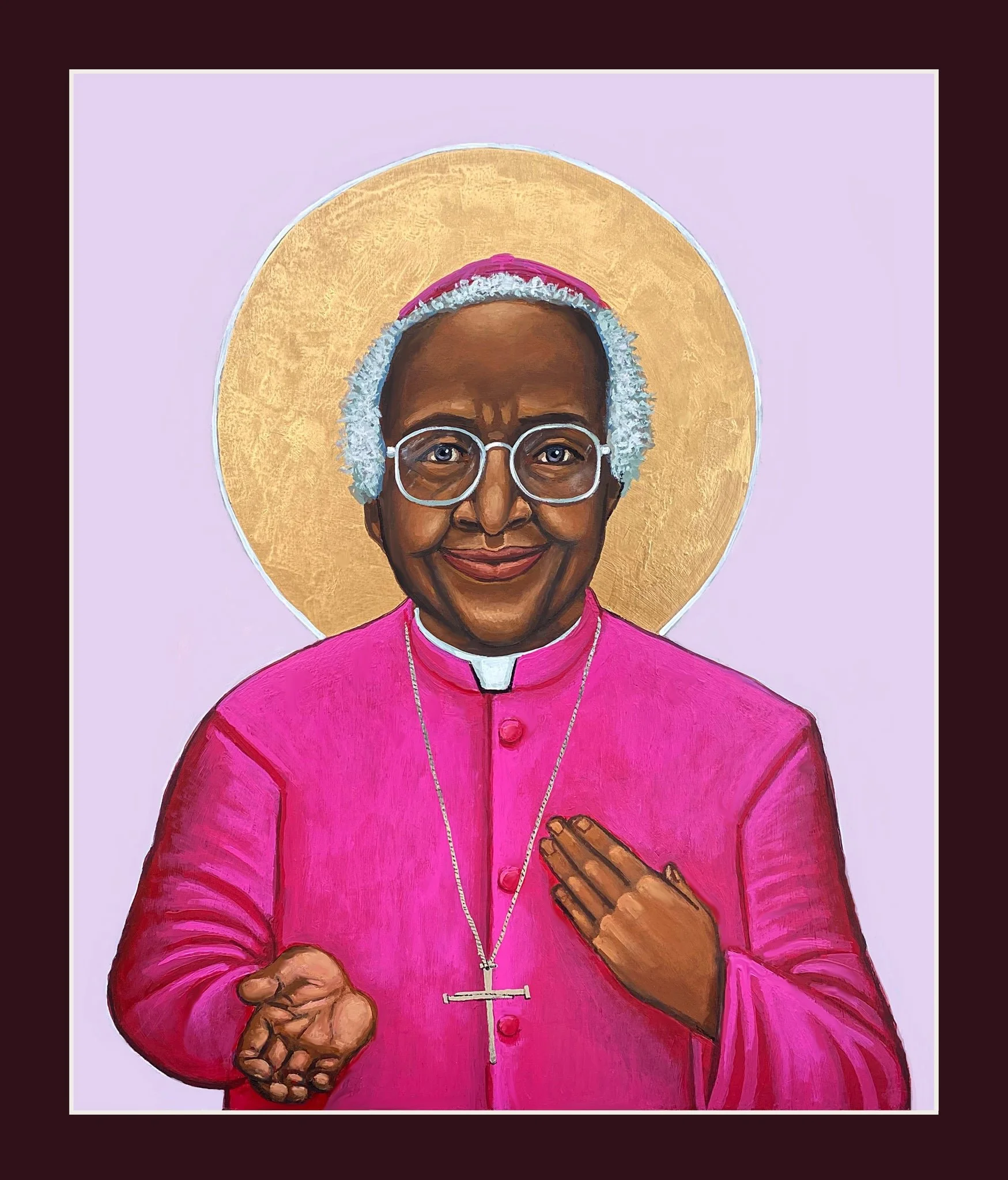
Archbishop Desmond Tutu.
And what I’ve loved about this series…is that these “saints” …were presented as humans – with all their imperfections and flaws.
And Archbishop Desmond Tutu was no different – controversies followed him at different points in his life also.
So the back story of “The Arch” as he’s fondly known in South Africa
Many of you will remember those images of an elderly statesman-like figure
that huge smile… the purple robes…he often wore
But before all of those … symbols of high office
“The Arch” was once just an African boy.
Born in 1931… sandwiched between 2 sisters in apartheid South Africa.
If anyone here born after the 90s does not know what Apartheid is, come and see me after the service
Now apartheid—meaning “apartness”—essentially, was a system of racial segregation in south Africa designed to maintain white minority rule over the non-white majority.
And it lasted over 40 years.
And apartheid wasn’t just politics - it was a system that shaped everyday life for non-white majority in Safa.
His father—a teacher.
His mother—a domestic worker.
So inequality wasn’t something distant - it was normal.
After high school. He became a teacher himself… and experienced the apartheid system from within – he saw how the system was designed to limit the progress of black children. It was embedded in the society.
He walked away.
After leaving his teaching career, and through influences of at least two church leaders Father Sekgphane and one Trevor Huddleston (an Anglican priest), he pursued formal theological training and was ordained as an Anglican priest in 1961.
That tells you something about the kind of man he was.
Ubuntu
Why Tutu?
Now, beyond the high-office, his great achievements and the global recognition.. the thing that really connects and draws me to him is the way he saw humanity and people.
He had a deep understanding of humanity.
That went against the grain.
And that comes down to one word – with Bantu-origins
Ubuntu. Which shaped his ideas.
Ubuntu.
Ubuntu is often explained like this:
“I am because we are.”
Or, in other words “a person is a person through other persons.”
And I love the simplicity of that idea…
that somehow my humanity is bound up in yours
and yours.
and yours.
Because this somewhat goes against everything we’re taught.
We’re often taught:
I build my life.
I make my choices.
I stand on my own.
But Ubuntu says—
no… you belong to other people.
Because Tutu lived under apartheid - a system that said some lives mattered more than others - it’s even more remarkable that he held this view and used it as a compass for all his work.
And he didn’t just challenge it politically - he challenged it spiritually.
In his role as the chair of the Truth and Reconciliation Commission
He said, “if you harm someone else… you deny them of their rights and in turn you damage your own humanity!"
After apartheid… there could have been revenge.
And people would have understood that.
But instead, inder the leadership of the Arch he focused on creating spaces for
truth - honesty - acknowledgement - and even… forgiveness.
Not because justice didn’t matter but because healing mattered too.
Beyond racial injustice, he tirelessly campaigned for other causes with the same ubuntu fervour …on the issue of gay rights in the church.
In 2013 at the launch of a UN backed campaign to promote gay rights - Desmond Tutu said “I would refuse to go to a homophobic heaven. No, I would say, sorry, I mean I would much rather go to the other place. I would not worship a God who is homophobic and that is how deeply I feel about this. I am as passionate about this campaign as I ever was about apartheid. For me, it is at the same level.”
But was does that all mean for us today.
Even here… in this warm, comfortable church …
Many people, children, mothers, young men in far away land of different cultures and religions are still suffering.
Ubuntu says our lives are connected to theirs.
My challenge to us is to recognise that our lives are connected to people we may never meet or see.
That’s Ubuntu - “a person is a person through other persons.”
Sometimes it’s easy to think - Apartheid - that was a different place… different time.
But I’ m sure I don’t have to remind you – that “bad things happen because history has an uncanny way of repeating itself and we still have a job to do
Its even more urgent!
But we still see injustice.
We still see inequality.
And Ubuntu asks us—
what does it mean… to belong to each other… now?
Will we look away?
“a person is a person through other persons.”
King didn’t look away.
Julian didn’t look away.
Navalny didn’t look away.
Tutu didn’t look away.
So the question is… will we?
So, when I think about a saint I can believe in…
I think of someone who feels real.
And The Arch was that kind of person.
A husband.
A father.
A priest.
A fighter against injustice in all its ugly faces.
He was Someone who believed
I am because we are.
And if we really believe that… if we really believe we belong to each other
then injustice - whether near… or far - is never someone else’s problem.
It’s always ours.
So, the question isn’t just about what Desmond Tutu did…and the Ubuntu he gave to the world.
The question is
What ubuntu will you give to the world?
What will we do?
Amen.