
A talk by Martin Wroe on September 4th 2026.
I would like to introduce you to a new word. It was coined in 2016 by two French researchers in an essay called How Everything Can Collapse.
The word is ‘collapsology’.
It may refer to the economic system or the climate emergency. More recently it’s been wrapped up with fears of global conflict, the rise of extremist governments and the predicted threat of AI.
Collapsology. A sense that we are in an historic moment where, to quote the poet, the centre cannot hold and the world as we know it will collapse in on itself with unknown consequences.
Except that the consequences are, in another recent phrase, sub-optimal.
Sarah Wilson, an Australian writer, was for many years a climate activist.
In her new book, I eat the stars, she says that while she was always driven by the conviction that hope would save us… ‘it didn’t save us, reality caught up… and all the things we hoped would not happen happened.’
We did too little to avoid a climate emergency she says and now we’re in it. Things are collapsing.
‘I no longer have hope.’ She writes. We can’t fix it.
Collapsology is gathering pace and this reading of our days could make you worry.
For the life we know and this planet we share.
But we’re worried already. Parched fields, falling crop yields, talk of food shortages.
Young people especially, feel a sense of climate grief or climate anxiety.
A Professor of Global Ecology at the Greenbelt Festival last weekend asked people to raise a hand if they were worried… most hands went up.
Eighty years ago WH Auden coined the phrase The Age of Anxiety. It hasn’t gone away.
But then here’s Jesus in our reading this morning saying to his friends,
‘Don’t worry about your life… can worry add an hour to your life?’
Thank you Jesus but it's not helpful to suggest to a worried person that they stop worrying.
Does our worry reflect a lack of faith in God?
Surely if we trust in God things will be fine.
I talked about this with a friend I’ve known since my teens.
Relax, he smiled, the climate crisis is just part of earths cycle.
’It will work itself out,’ he said. ‘It will work itself out…’
We had a Christian version of a row.
I would describe it - this gives me a chance to introduce a word I have invented - as pious-aggressive.
I love my friend but I wonder if he’s fallen for a fatalistic theology where whatever will be will be - and everything ‘will work itself out’.
I am with Teresa of Avila in the C16th who said, ‘Ours are the eyes with which God looks compassionately on the world. Ours are the feet with which God walks to do good. Ours are the hands with which God blesses all the world…’
In other words, I tend to the view that we are often the answers to the prayers that god is praying for us.
I am with Hildegard of Bingen in the C12th, the saint who is looking at you from the top of this morning’s service sheet.
Born in 1098 in Germany’s Rhine Valley, Hildegard was a very sick child and her family put her in the care of Benedictine nuns.
From three years of age Hildegard began to have dramatic mystical experiences.
She felt enveloped in an inexplicable sense of warmth and light but she couldn’t tell anyone - first because she was a child, later because she was a woman in a world where men were the ones who did the god talk.
But in her early forties the visions were still happening. Now an Abbess and leading her own community of sisters, she began speaking about her mystical life.
She said it was like experiencing ‘a flow of light’ which ‘kindled her whole heart, not burning but warming’.
Her desire, she wrote, was to be ‘a feather on the breath of God’.
She gave these visions a name, Umbra Viventis Lucis - ‘Reflection of the Living Light’ - and they came to inform the path her life took.
Hildegard was a constant humm of prayer and creativity.
She wrote poetry and composed music - including the anthem the choir sang to open this service.
More of her chants survive than by any composer from the Middle Ages.
'There is the music of heaven in all things,’ she said, ‘the ethereal qualities of music elevate the soul while ushering in the spirit.'
She was a tireless organizer and at the Abbey near Bingen she loved gardening and growing food.
She wrote books on botany, biology and medicine while also becoming a confidante to powerful clerics in the church who couldn’t deny her spiritual authority.
When Hildegard attacked church corruption she got away with it because she was known to be so holy.
She also coined a new word. Seeing God's ‘living power of light’, as she called it, in all creation, she named this power viriditas.
She seems to have understood how plants transform the light of the sun into energy, what today we call photosynthesis.
She sensed that this holy world, each sacred creature – you and I - that we are all infused with divine light. That everything is connected. Lit up.
Like Norman or Gary or Luz or Sam, some of our gardeners here at St Luke’s, Hildegard found gardening meditative – inviting your thoughts to organise themselves, calming you, teaching you.
So here is this outstanding human being, a person devoted to love and light, to prayer and community, to activism and the good earth… but now listen to these words she said at the end of her life.
‘From earliest childhood I have not even for one hour lived free from anxiety.’
‘From earliest childhood I have not even for one hour lived free from anxiety.’
A woman of prayer and protest, an organizer and activist and yet Hildegard lived everyday with her doubts.
She knew the words of Jesus that we heard earlier - do not worry….
She knew what the Christian teacher Paul said about bringing your whole life to god in prayer and how the peace of god will guard your hearts and minds…
… and some days it did… but still anxiety remained her companion.
What Hildegard's life tells us is that you can be worried and hopeful at the same time.
You can be full of faith and still harbour doubt.
You can, as Gloria Steinem who died this week put it (quoting psychologist Susan Jeffers) you can feel the fear and do it anyway…
The scientist I mentioned at the Greenbelt festival last weekend - the one who asked us if we were worried - is Professor Tom Crowther.
His book, Nature’s Echo, explores how feedback loops, the chains of cause and effect, are essential in the way ecosystems regulate themselves.
He sees it among people too. He argues that our emotional responses will shape the world we are entering…that panic, which is the risk of the collapsologist approach, will propagate more of the same energy.
Defeatism and despair can become a loop that begets defeatism and despair … but conversely finding joy in nature and working for environmental justice creates its own positive loop.
Our media diet can lead us into a 24hour disaster drama… drowning out the quiet incremental news where nature is being dramatically regenerated - from crops to forests to water systems.
Jesus is walking in the fields in the story where he invites us not to worry, he is considering the lilies.
Like him, we can find consolation in this natural world of which we are part…
in the lilies of the field, in the trees on our street, in the flowers in the window box, walking along the canal, the clouds scudding the sky, lying under the autumn sun in one of London’s great parks.
In the Spring I bumped into our friend Andy Harrison who was standing, motionless, under a cherry tree.
Andy is a rare soul so I wasn’t too surprised but I wandered up and asked him what he was doing.
I’m listening to the humming, he said, can you hear it?
It’s the blossom he said, when you pass a tree in blossom, stand quietly underneath and you will hear the bees buzzing… as pollination takes place.
Later in the day I tried this experiment.
It took a moment but there it was, the gentle hum and buzz. A peace that passed all understanding.
Our second reading was from Wendell Berry, poet and farmer from rural America, who died this week at 92.
He captured the consolations of nature in one of his most famous poems, The Peace of Wild Things. He wrote,
When despair for the world grows in me
and I wake in the night at the least sound
in fear of what my life and my children’s lives may be,
I go and lie down where the wood drake
rests in his beauty on the water, and the great heron feeds.
I come into the peace of wild things
who do not tax their lives with forethought
of grief. I come into the presence of still water.
And I feel above me the day-blind stars
waiting with their light. For a time
I rest in the grace of the world, and am free.
I come into the peace of wild things… this is the place where he can lay his anxiety down.
It is among the lilies of the field as Jesus put it, where we find we are all part of a greater story.
Here is the viriditas that Hildegard saw - the divine presence, this holy world, each sacred creature – all of us infused with light. Lit up. Everything connected.
Here is the joy in our sorrow, the hope in our sadness.
We don’t turn away from reality - we turn toward reality with joy.
As Wendell Berry put it in another poem, the mad farmer liberation front,
‘Expect the end of the world. Laugh.
Laughter is immeasurable.
Be joyful though you have considered all the facts….
…. practise resurrection.’
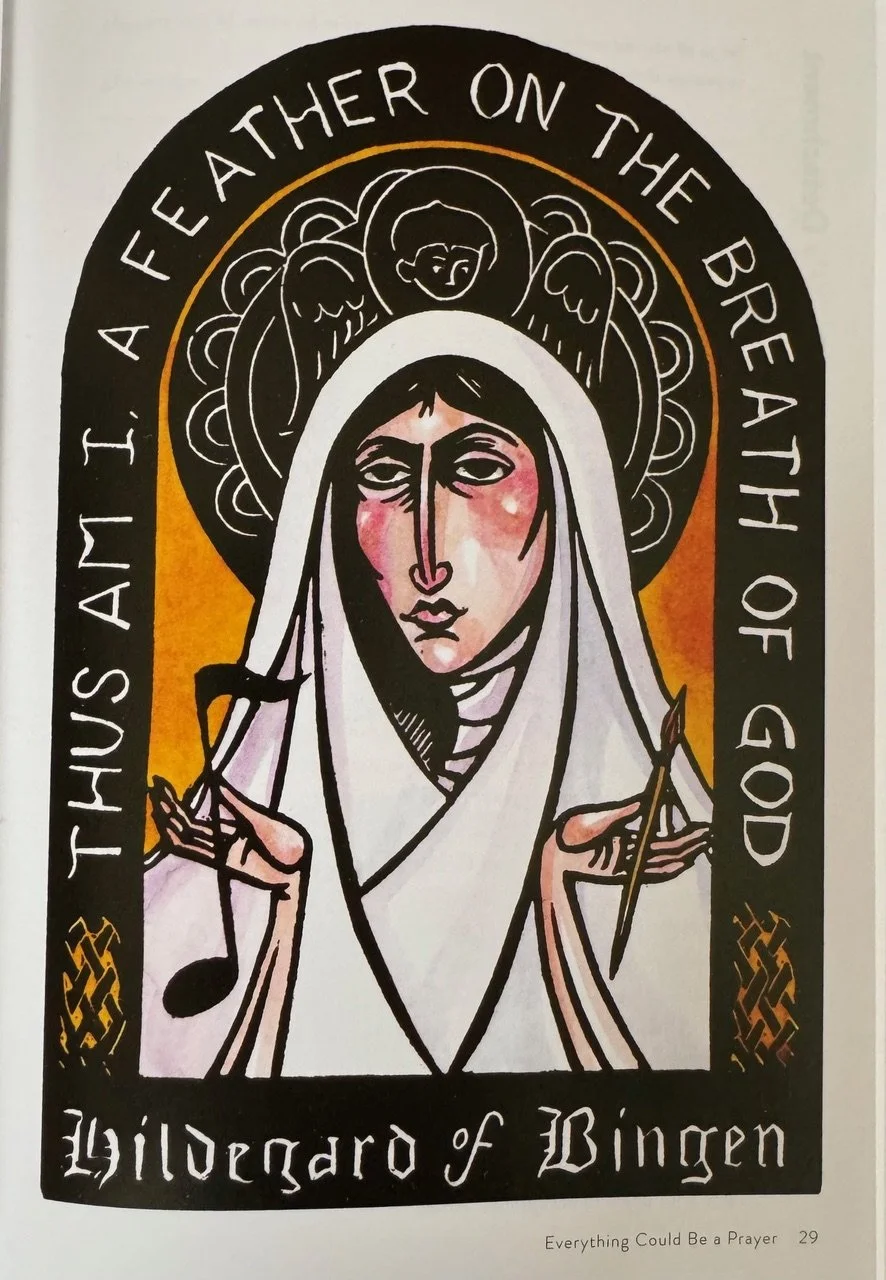
Painting of Hildegard of Bingen by Kreg Yingst from Everything Could Be A Prayer, 100 Portraits of Saints and Mystics. (Broadleaf Books) https://kregyingst.com/jazzindex.html
