A talk on food, hospitality and our monthly community lunch by Madeleine Ballard on August 22nd 2026.
Jesus got himself killed, in part, over who he ate with.
The serious religious people of his day kept a running account of the meals he should not have been at. We heard in our reading today in Luke 19 how he ate at the house of a tax collector named Zacchaeus, a man who had grown rich by squeezing his own neighbours and had the occupying power enforce it. This was not the only time: In Luke 7, at a Pharisee's dinner party, he let a sex worker kneel and wash his feet. In Luke 5, he sat down at a banquet thrown by Levi and filled with tax collectors and complaints flowed in.
Jesus was called a glutton, a drunkard, and a friend of sinners. The strange thing is that he seems to have earned the reputation. If you read the Gospel of Luke straight through, in the words of author and theologian Robert Karris, you notice that Jesus is almost always at a meal, or on his way to one, or just getting up from one.
The fact is, as we hear in Matthew 11, Jesus came eating and drinking. And he kept choosing the “wrong” dinner companions, on purpose.
I think that we as a church may have decided that this was a charming detail. Jesus was a warm man, he liked people, he enjoyed a good dinner party—lovely. And then we move on to the serious business of faith, which we assume happens somewhere more dignified than a kitchen.
I've come to think we have that backwards. The meal was never a side-show. As Pastor John Mark Comer has shared: for Jesus, the table was the method.
Meals have always been what British anthropologist Mary Douglas calls “boundary markers”--a way of saying who belonged. In Jesus's day the sorting was open and severe. Tax collectors, prostitutes, lepers, gentiles, the chronically ill: the wrong sort of person could not come near the table, because contact would defile the meal and everyone at it. In other words, religious authorities maintained a system that announced, in the most ordinary and repeating way, who was in and who was out. Over time, society shifted from purity to property. Here in London it was not uncommon in the 1950s to see signs on hotels and golf clubs that read: No Blacks, No Irish, No Dogs.
And we can shake our heads at that history, but the fact is exclusion is still rampant in our city: a £250 tasting menu needs no door policy, and most of us still eat with people more or less like us. Same background, same income, same politics.
So when Jesus invited himself to Zacchaeus + Levi's houses, it’s no surprise the crowd did not say, “how kind.” As we read in the book Fringe Dweller during our Lent reading group, they muttered: “why does he eat with scum?”
Yet by the end of the evening, Zacchaeus is on his feet, giving away half his fortune and repaying everyone he cheated four times over. Nobody preached at him. Nobody handed him a pamphlet. He sat at a table where, against every expectation, he was welcome...and it turned his life inside out. That is the pattern of Jesus’ time on earth: People transformed by Kingdom welcome, over and over, one meal at a time.
In fact all through the New Testament, we followers of Jesus are commanded to eat and drink together in community: in Romans 12:13 “be eager to show hospitality”: in 1 Peter 4:8-9 “Above all, love each other deeply.” How? “Offer hospitality to one another without grumbling (!!)” (We’ve all done it :) In Hebrews 13, “Keep on loving one another as brothers and sisters.” How? By showing “hospitality to strangers, for by so doing some people have hosted angels without knowing it.”
Notice that Jesus’ version of hospitality is different from ours. We so often make hospitality into another performance of status — a curated guest list, an immaculate house, a host hoping to be admired, and then expecting a reciprocal invitation in return.
You know, my wife who is here today used to live in Central America where “mi casa es su casa” - my home is your home - is a common saying. Since we’ve moved to Britain we’ve noticed a much more common phrase: “a man’s home is his castle.” One that I also heard a lot growing up in Canada. I've learned two things: 1) Never her castle, apparently. And 2) the phrase originated as a legal claim: the king's men cannot enter your home without due process. But it's clear to me–and probably most of us—that what started as a shield against tyranny…against having your door broken down…has become a cultural reflex not to open it. Moral permission for isolation. Or as we said in our prayer this morning "taking refuge too often in the familiar.”
Jesus's hospitality runs the other way entirely. The door is always open. The Greek word for hospitality– philoxenia–literally means love of the stranger: the outsider, the newcomer, the fringe dweller. No guest list, because there is always room for one more. No performance, because the host kneels to serve rather than stands to shine. No firm line, even, between host and guest, because Jesus was always somehow both. In Luke 14 Jesus makes this explicit, saying: when you give a feast, do not invite your friends or your rich neighbours, who will only invite you back. Invite the poor, the crippled, the lame, the blind—the ones who cannot repay you.
Eating and drinking in community is central to the justice of God’s Kingdom. In Isaiah 58 God dismisses a people who fast and pray faithfully while injustice runs rampant around them, and the correction is startlingly domestic: share your bread with the hungry, bring the homeless poor into your house. Not “send a donation.” We heard it again sharply in our second reading from Matthew: I was hungry and you gave me something to eat. I was thirsty and you gave me something to drink. I was a stranger and you invited me in. As Jesus, said: whatever you did for one of the least of these, you did for me. Jesus’ Kingdom is not just “spiritual” it is practical–the stranger at our table is Christ. And he is profoundly concerned with who can afford to eat, what cruelty we tolerate in the systems that feed us, and if we still carry a sense of humble gratitude for food itself as a gracious gift of God to be received with thanks and shared without grumbling.
So central to Jesus’ vision was this version of hospitality and justice that for hundreds of years the table literally was the church. In Chapter 2 of the books of Acts, in the Bible, we read a short list of what the first believers did with their days: they listened to the teaching, they broke bread in one another's homes, they prayed, they gave to anyone who had need, and they broke bread in one another's homes and ate together with glad and sincere hearts. Eating together is the only practice listed twice. Twice for emphasis. Twice in six verses: the community that would outlast the empire was not, at first, a building you went to. It was a meal you shared.
In a few minutes we'll come up here for a wafer and a sip of wine. But when Jesus said "do this in remembrance of me," it was dinner together. Over the centuries it shrank to a wafer and a thimble of juice, taken in silent introspection.That quiet, searching work is necessary. But we can’t forget the second part: come to the table. Sit down together and be glad.
So. Once a month, in this church, we set a table: community lunch.
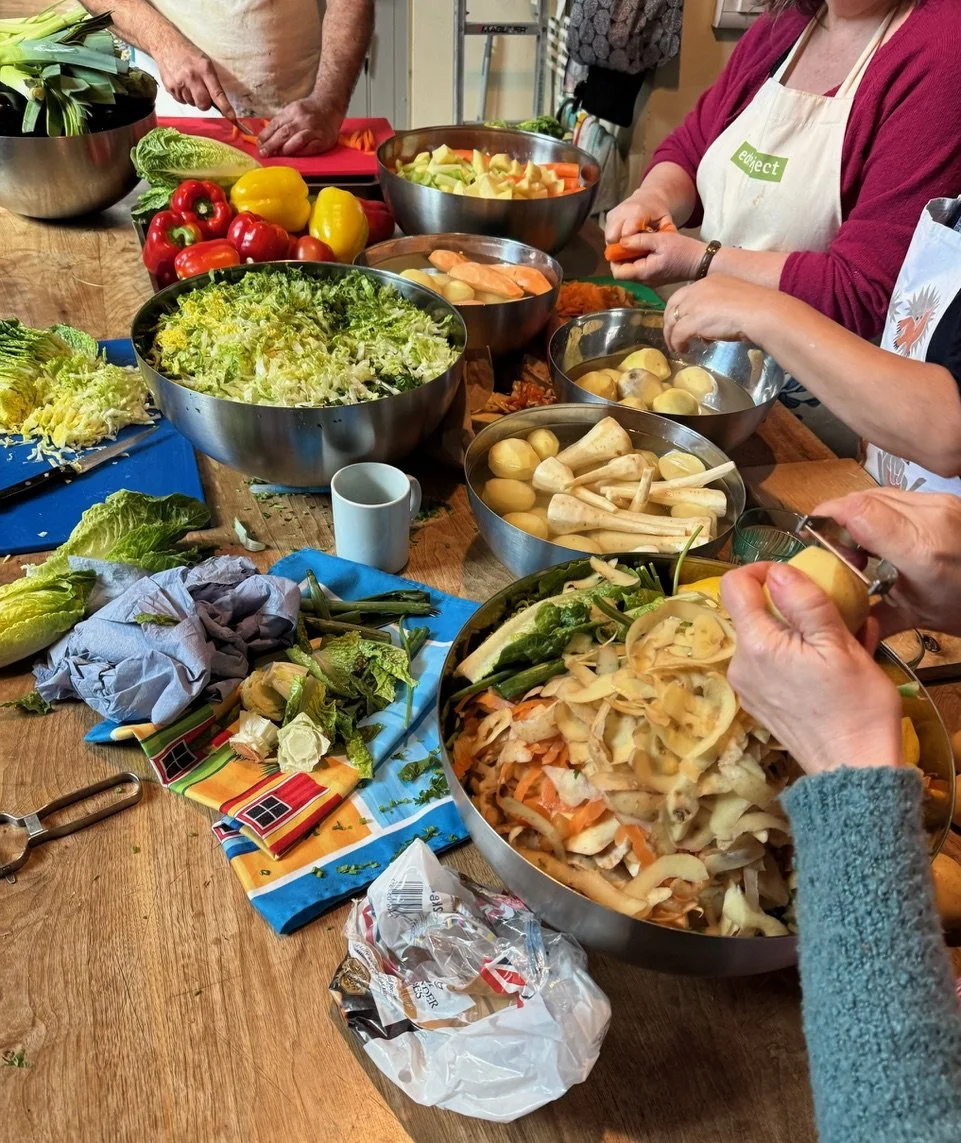
We cook for about seventy people and eat side by side — congregation and neighbourhood, people from the shelters, people from just down the road, people who under any other arrangement in modern Britain would never share a meal with one another. Everyone who comes through that door is a guest at the same table, and everyone, in some small way, is a host of it too.
It’s my favourite part of this church. I want it to last and I want it to grow. And the way you make a good thing last is to make it easy: easy to join, easy to contribute, and shared by enough of us that it is a joyful, easy yoke.
So…what role would you like to play in this unfolding feast?
To be clear: you do not need to know how to cook. We need a few hands to chop and stir for an hour before service. A few people to rearrange chairs and tables at the end of the service for 20 minutes. We need our clean up captain and clean up crew. And we need every single one of us to play the most important role in the building: partake joyfully in community. Sit down next to someone you don't know. Too many of us are having meals alone. As our service sheet says every week: this is the opportunity to connect with the new friend you’re about to make.
Ahhh but I’m busy. You know what? So am I. But like you, I eat. Two or three times a day, every day of my life. Nobody is asking you to bolt one more impossible thing onto a full life. I am asking you to take the most ordinary act, one you perform 21 times a week, 84 times a month and share just one of those, together. To resist the cultural urge to run back to the safety of your so-called castle and instead run toward His kingdom–of hospitality, of justice, of togetherness —and spend a meal joyfully bringing it to earth as it is in heaven. One crumble, conversation, one clean up at a time.
On Sunday the 13th of September, straight after the service, we are running a short, friendly intake. You can sign up today and on the poster board in the back of the room. If the 13th doesn't work, just put an asterisk next to your name and we’ll find you another time and make it easy for you to get involved.
Jesus came eating and drinking. He set a table wide enough for the very people everyone else had counted out, and he asked his friends to keep setting it after he was gone. That table is still here. There is a place for you at it. Come and take it — and then help us pull up a few more chairs.